
The DHA Exam is an important step for healthcare professionals who want to work in Dubai. Doctors, nurses, dentists, pharmacists, optometrists, physiotherapists, radiographers, dental hygienists, laboratory technologists, and many allied health applicants may need to pass a Dubai Health Authority assessment before moving forward in the licensing process.
Most candidates already know that the exam matters. The problem is not motivation. The problem is preparation direction. Many applicants study for long hours but use the wrong MCQs. Others understand clinical practice but do not know how to answer computer-based questions under time pressure. Some candidates focus only on exam content and forget Sheryan, DataFlow, Prometric rules, document readiness, or retake planning.
This complete guide explains the most common DHA preparation errors and how to avoid them. The goal is simple: help you prepare smarter, reduce stress, and approach the DHA license exam with a clear strategy.
Need a Smarter DHA Exam Plan?
Use specialty-focused MCQs, timed mock tests, and structured revision to avoid the most common mistakes before exam day.
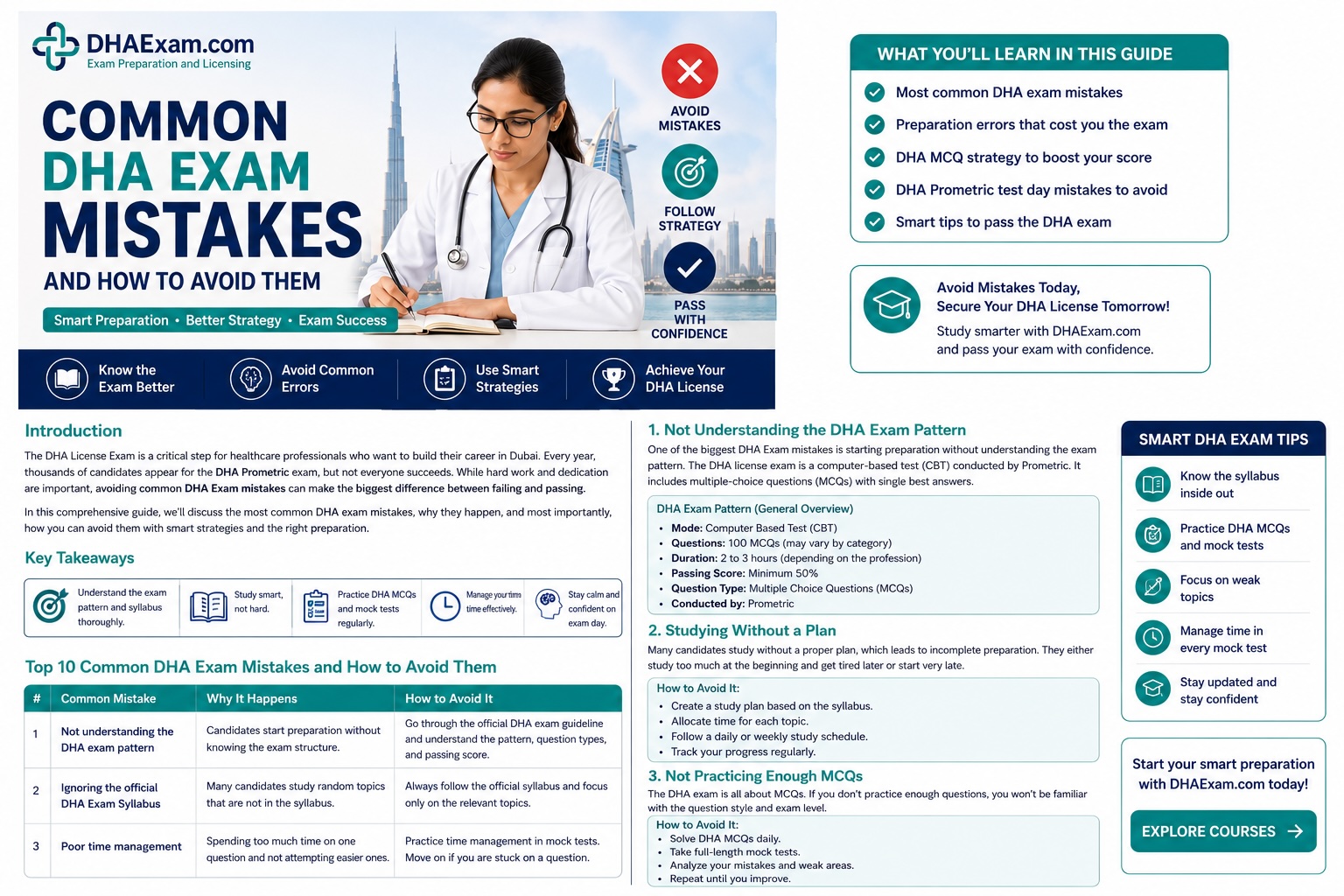
Key Takeaways: DHA Exam Mistakes to Avoid
- Do not prepare with random MCQs. Your practice questions must match your profession and specialty.
- Do not ignore the DHA CBT exam pattern. Understand how multiple-choice questions are presented and practice under timed conditions.
- Do not wait until the final week for mock tests. Mock tests should guide your revision from the middle of preparation.
- Do not memorize blindly. Understand why each answer is correct and why the other options are wrong.
- Do not neglect Prometric rules. Bring valid ID, arrive early, and follow test center instructions carefully.
Mistake 1: Starting Without Understanding the DHA Licensing Process
One of the biggest DHA Exam mistakes is treating the exam as the only step in the licensing journey. The assessment is important, but it is part of a larger process. Candidates may also need eligibility review, Primary Source Verification or DataFlow, professional registration, and license activation through a DHA-licensed healthcare facility.
DHA’s Sheryan system is the official platform used for professional licensing services. DHA’s Get Registered service explains that applicants may need to submit required documents for Primary Source Verification and pass any required computer-based testing assessment. It also notes that CBT assessment and DataFlow verification can be performed in parallel.
How to Avoid This Mistake
- Confirm your professional title before studying or booking.
- Use the Sheryan Self Assessment Tool where applicable.
- Check if you need CBT, oral assessment, or may qualify for exemption.
- Read the DHA Exam eligibility requirements guide.
- Review DHA Exam exemption rules if you have international qualifications or previous licenses.
Mistake 2: Choosing the Wrong DHA MCQ Material
Many candidates collect free PDFs, old screenshots, WhatsApp files, social media questions, or mixed healthcare MCQs. This may feel productive, but it often creates confusion. A nurse does not need the same question bank as a dentist. A pharmacist does not need the same questions as a general practitioner. A physiotherapist, optometrist, laboratory technologist, and dental hygienist also have different exam focus areas.
Using the wrong question bank is one of the most damaging DHA preparation errors. It wastes time and gives you a false sense of readiness. You may answer hundreds of questions but still miss the topics that matter for your actual title.
How to Avoid This Mistake
Choose MCQs that match your exact profession and specialty:
- DHA GP exam questions for general practitioner candidates.
- DHA Nursing Exam questions for nurses.
- DHA Dental Exam questions for dentists.
- DHA Pharmacist Exam questions for pharmacists.
- DHA Optometrist Exam guide for optometry candidates.
- DHA Allied Health Exam resources for allied health professionals.
If you are confused about packages, read how to choose the right DHA Exam MCQ package.
Mistake 3: Ignoring the DHA Exam Syllabus and Pattern
Another common mistake is studying without understanding the exam structure. Many DHA assessments are computer-based tests with multiple-choice questions, but the number of questions, duration, pass score, assessment mode, and content may vary by title.
DHA advises candidates to check the Mode of Exam per Specialty and CBT Assessment Guideline for details such as duration, number of questions, passing score, fees, content, and references. This means you should not assume that every DHA test is identical.
How to Avoid This Mistake
- Review the DHA Exam syllabus and pattern guide.
- Check your exact professional title and exam mode.
- Practice according to your specialty, not general healthcare content.
- Use timed practice to simulate the DHA CBT exam environment.
| Common Error | Better Strategy |
|---|---|
| Studying random healthcare MCQs | Use specialty-specific DHA MCQs based on your applied title. |
| Ignoring timed practice | Take timed mock tests to improve speed and focus. |
| Memorizing answer keys | Understand concepts, explanations, and clinical reasoning. |
Mistake 4: Memorizing Answers Without Understanding Concepts
Memorizing repeated answers may help with simple recall, but it is not a safe long-term strategy. The DHA Exam often checks applied knowledge. A clinical scenario can be written in several different ways while testing the same concept. If you only memorized one answer, you may get confused when the wording changes.
A stronger DHA MCQ strategy is to understand the logic behind the answer. Ask yourself: Why is this option correct? Why are the other options wrong? What clue in the question helped me choose the answer? What would I do if the case was slightly different?
How to Avoid This Mistake
- Read explanations after every practice session.
- Write down repeated weak topics.
- Review the concept behind every wrong answer.
- Do not only repeat the same MCQ; study the reason behind it.
- Use a mistake notebook for topics that confuse you repeatedly.
Mistake 5: Starting Mock Tests Too Late
Many candidates take their first mock test only a few days before the exam. This is too late. A mock test is not only a final check. It is a diagnostic tool that tells you where your preparation is weak.
A good mock test plan helps you measure speed, accuracy, clinical reasoning, and confidence. It also reduces exam fear because you become familiar with answering questions under time pressure.
| Preparation Stage | Mock Test Action | Goal |
|---|---|---|
| Early preparation | Take one baseline mock | Identify weak areas. |
| Middle preparation | Take weekly mock tests | Measure improvement. |
| Final preparation | Take timed full practice tests | Build exam readiness. |
Improve Your DHA Mock Test Score
Do not just take mock tests. Review every mistake, revise weak topics, and repeat practice until your score becomes stable.
Mistake 6: Poor Time Management During DHA MCQs
Time pressure is one of the biggest problems in computer-based exams. Some candidates spend too long on one difficult question and then rush through easier questions later. Others move too fast and make careless mistakes.
Your goal is not to answer every question perfectly on the first reading. Your goal is to complete the test calmly, avoid wasting time, and choose the best answer based on the information given.
Practical DHA MCQ Strategy
- Read the question stem carefully before checking the options.
- Identify the main clinical clue or professional issue.
- Eliminate obviously wrong options first.
- Choose the safest and most appropriate answer when two options seem close.
- Do not spend too long on one difficult question.
- If review is allowed, mark uncertain questions and return later.
- Use the final minutes to review, not panic.
Mistake 7: Ignoring Prometric Test Center Rules
Many DHA CBT exams are delivered through Prometric. Prometric test centers follow check-in, identification, and security procedures. Candidates who ignore these rules may face avoidable stress before the test even begins.
Prometric’s test-day guidance advises candidates to bring a valid, non-expired government-issued ID with a current photo and signature. Prometric’s test-day information also commonly advises arriving around 30 minutes before the scheduled appointment to allow time for check-in.
DHA Prometric Tips for Test Day
- Check your appointment confirmation before exam day.
- Bring the correct original identification document.
- Arrive early at the test center.
- Do not bring unnecessary items into the testing area.
- Follow the test center administrator’s instructions calmly.
- Wear comfortable clothing and consider layers because room temperature may vary.
- Sleep properly the night before the exam.
For a full final checklist, read the DHA Exam checklist before test day.
Mistake 8: Ignoring DataFlow and Document Readiness
Some candidates focus only on passing the exam and forget the licensing documents. This can delay progress even after a pass result. The DHA process may involve Primary Source Verification, also known as DataFlow, along with professional registration requirements.
Common document mistakes include unclear experience certificates, expired good standing certificates, name mismatches, missing transcripts, unclear license copies, and incomplete employment evidence.
How to Avoid This Mistake
- Prepare documents early instead of waiting until after the exam.
- Check that names match across passport, degree, license, and experience certificates.
- Make sure experience letters clearly mention role, dates, and facility details.
- Keep your Good Standing Certificate valid and updated.
- Read the DHA DataFlow verification guide.
Mistake 9: Studying Without a Revision Plan
Many candidates study daily but do not revise properly. They complete questions once and move on. The problem is that information fades, especially when you are preparing alongside work, family, or travel responsibilities.
A strong revision plan should include daily MCQs, weekly mock tests, repeated review of wrong answers, high-yield notes, and final-week consolidation. Revision is not about reading everything again. It is about repeating the topics that are most likely to affect your score.
| Week | Focus | Action |
|---|---|---|
| Week 1 | Core topics | Study topic-wise MCQs and basic concepts. |
| Week 2 | Weak areas | Review mistakes and practice related questions. |
| Week 3 | Mixed practice | Take mock tests and improve timing. |
| Week 4 | Final revision | Repeat difficult MCQs, revise notes, and rest properly. |
Mistake 10: Ignoring Weak Topics After Mock Tests
A mock test is useful only if you review it properly. Many candidates check the score, feel happy or disappointed, and then move to the next test. That is not enough. The real learning happens during review.
After every mock test, divide wrong answers into categories. Was it a knowledge gap? A careless reading mistake? A time pressure mistake? A misunderstanding of the question? This helps you know what needs fixing.
Simple Mock Review Method
- Knowledge mistake: Revise the topic from the beginning.
- Reading mistake: Slow down and underline key words during practice.
- Timing mistake: Practice timed sets of 25 to 50 questions.
- Confusion between two options: Study the difference between similar diagnoses, drugs, procedures, or rules.
Mistake 11: Overstudying New Topics in the Final Week
The final week is not the best time to open too many new topics. This often creates anxiety. Candidates start feeling that they know nothing, even after weeks of study. Instead, the final week should focus on consolidation.
Use the final days to review your notes, repeat wrong questions, complete a few timed sessions, and prepare your documents for the test center. Sleep, hydration, and calm thinking matter more than last-minute information overload.
Final Week Priorities
- Revise your mistake notebook.
- Repeat high-yield MCQs.
- Take one or two timed practice sessions.
- Check your Prometric confirmation and ID.
- Avoid late-night cramming before exam day.
Mistake 12: Panicking After a DHA Exam Fail Result
A fail result can feel discouraging, but it is not the end of your Dubai healthcare career. Many candidates pass after changing their preparation method. The mistake is rushing into another attempt without understanding what went wrong.
If you fail, check your official result status in Sheryan, review the available retake process, and rebuild your plan. Study with better MCQs, use mock tests more seriously, and improve weak topics before booking again.
For detailed guidance, read the DHA Exam result guide.
Quick Checklist to Avoid DHA Exam Mistakes
- Confirm your DHA professional title.
- Check your exam pattern and assessment mode.
- Study from specialty-specific MCQs.
- Take mock tests early and regularly.
- Review explanations, not only answer keys.
- Track repeated weak topics.
- Practice time management.
- Follow Prometric test-day rules.
- Prepare DataFlow and licensing documents early.
- Rest properly before the exam.
Helpful DHAExam.com Resources
- DHA Exam Preparation Packages
- DHA Exam Syllabus and Pattern Explained
- How to Choose the Right DHA Exam MCQ Package
- DHA Exam Checklist Before Test Day
- DHA Exam Result Guide
- DHA DataFlow Verification Guide
- DHA vs MOH vs DOH Exam Differences
- DHA Dental Hygiene Exam MCQs
- DHA Anesthesia Exam Questions
Extra DHA Exam Tips for Busy Healthcare Professionals
Many DHA candidates prepare while working full-time, handling family responsibilities, or waiting for licensing documents. If your schedule is busy, do not depend on long study sessions only. Short, focused practice can be more effective than irregular marathon study. Try to complete a fixed number of questions daily, even if it is only 30 to 50 MCQs. The consistency matters more than studying once a week for many hours.
Use your commute, breaks, or quiet evening time for light review, but keep mock tests for a proper distraction-free environment. When you are tired, revise explanations or read notes. When you are fresh, attempt new questions and timed sets. This keeps your preparation realistic and reduces burnout.
Another useful tip is to separate “learning mode” from “exam mode.” In learning mode, take your time and understand every answer. In exam mode, use a timer and practice making decisions quickly. Both skills are needed for the real DHA CBT exam.