
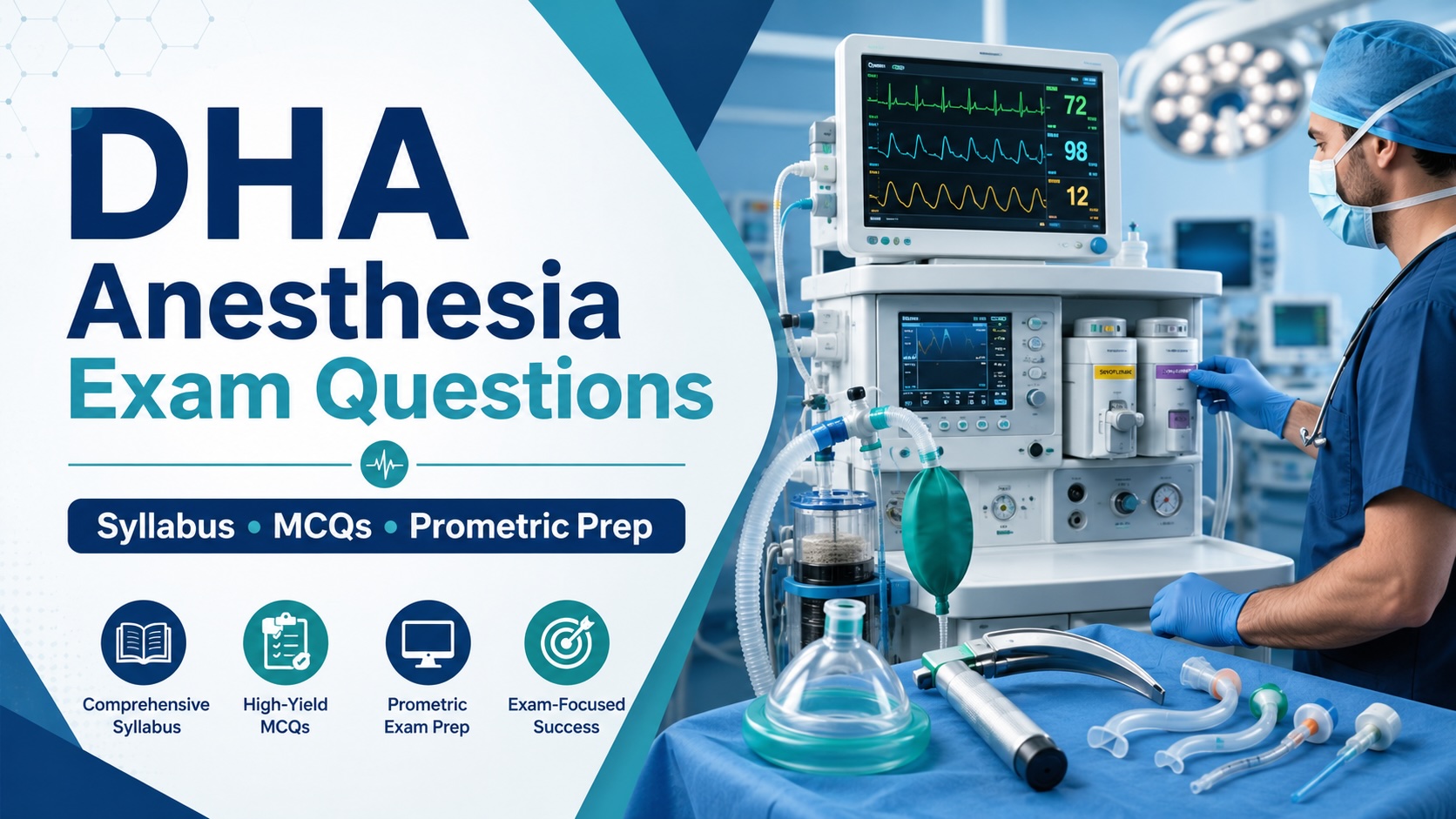
DHA Anesthesia Exam Questions and Syllabus
The DHA Anesthesia Exam Questions topic is important for anesthesia technicians and anesthesia technologists who want to work in Dubai under the Dubai Health Authority licensing pathway. These allied health professionals support anesthesia services, prepare equipment, assist with airway and monitoring setup, maintain patient safety, support crisis response, and work closely with anesthesiologists and surgical teams.
Table of Contents
ToggleBecause the role is practical and safety-focused, the exam is not only about memorizing facts. Candidates should understand anesthesia machines, respiratory and airway support, cardiovascular monitoring, transfusion safety, infection control, general anesthesia, regional anesthesia, obstetric anesthesia, professional ethics, and emergency response.
This blog gives you a complete preparation roadmap for the DHA Anesthesia Prometric assessment. It explains the exam pattern, syllabus areas, how to use DHA Anesthesia MCQs, how to prepare with a structured study plan, and how to avoid common preparation mistakes before test day.
Start DHA Anesthesia Exam Preparation
Use anesthesia-focused MCQs, topic-wise revision, and timed mock tests to prepare for the DHA anesthesia technician or technologist assessment.
Key Takeaways
- The DHA anesthesia assessment is under Allied Health. Anesthesia Technician and Anesthesia Technologist are listed as allied healthcare titles in DHA’s CBT guideline.
- The anesthesia technician exam is listed as ANA5701. DHA guidance lists 150 questions, 3 hours, USD 240 fee, and 55% pass score.
- The anesthesia technologist exam is listed as ANA5702. DHA guidance lists 150 questions, 3 hours, USD 240 fee, and 60% pass score.
- Syllabus topics are practical and safety-focused. Important areas include airway, anesthesia machine, respiratory, cardiovascular, transfusion, resuscitation, CNS, infection control, ethics, obstetric anesthesia, general anesthesia, and regional anesthesia.
- Mock tests are essential. Timed DHA Anesthesia MCQs help improve speed, confidence, and exam readiness.
DHA Anesthesia Exam Pattern: Technician vs Technologist
DHA’s official CBT Assessment Guideline lists both Anesthesia Technician and Anesthesia Technologist under the Allied Health category. Both are computer-based assessments with multiple-choice questions. The syllabus areas are very similar, but the pass score and exam code differ.
| Assessment Title | Code | Questions | Duration | Pass Score |
|---|---|---|---|---|
| Anesthesia Technician | ANA5701 | 150 | 3 hours | 55% |
| Anesthesia Technologist | ANA5702 | 150 | 3 hours | 60% |
Because exam formats and pass scores can change, always verify the latest DHA CBT guideline and Sheryan information before booking. For a broader overview, read DHA Exam syllabus and pattern explained.
What Does the DHA Anesthesia Syllabus Cover?
The DHA anesthesia syllabus focuses on core anesthesia support knowledge and safe clinical practice. It is designed for candidates who need to understand equipment, airway support, monitoring, crisis response, and operating-room safety.
The official DHA CBT guideline lists the following coverage areas for both anesthesia technician and anesthesia technologist assessments:
- Respiratory / Airway
- Anesthesia Machine
- Respiratory
- Cardiovascular
- Transfusion
- Resuscitation and Crisis
- Central Nervous System
- Infection Control
- Professionalism and Ethics
- Obstetrics Anesthesia
- General Anesthesia
- Regional Anesthesia
These topics show that the exam is practical. You should not study only definitions. You must understand how anesthesia equipment works, what problems can happen, how to respond safely, and how to support the anesthesia team during routine and emergency cases.
Important Topic 1: Respiratory and Airway
Airway knowledge is one of the most important areas in the anesthesia technician exam and anesthesia technologist exam. Candidates should understand airway anatomy, airway assessment basics, oxygen delivery devices, airway adjuncts, mask ventilation, endotracheal tube sizes, laryngeal mask airway basics, suction preparation, and oxygen safety.
Questions may ask about equipment selection, airway obstruction signs, oxygen delivery, ventilation support, or urgent preparation during difficult airway situations. Even if the anesthesiologist leads airway management, anesthesia support staff must prepare equipment quickly and correctly.
High-Yield Airway Topics
- Oxygen delivery systems
- Bag-valve-mask setup
- Endotracheal tubes and cuff checks
- Airway adjuncts
- Suction equipment
- Difficult airway cart preparation
- Capnography basics
- Signs of airway obstruction
Important Topic 2: Anesthesia Machine
The anesthesia machine is a major syllabus area. Candidates should understand machine components, gas supply, flowmeters, vaporizers, breathing circuits, oxygen analyzer, scavenging system, alarms, soda lime, ventilator basics, and safety checks.
Many DHA Anesthesia MCQs may test machine checks, common equipment problems, circuit leaks, oxygen failure, vaporizer issues, or breathing system troubleshooting. This is a practical topic where concept understanding matters more than memorization.
Machine Preparation Checklist
- Check oxygen and backup oxygen supply.
- Inspect breathing circuit connections.
- Check reservoir bag and ventilator function.
- Confirm vaporizer level and correct seating.
- Check suction and airway equipment.
- Confirm monitors and alarms are working.
- Check soda lime condition and canister connection.
Important Topic 3: Respiratory System and Ventilation
Respiratory questions may cover ventilation, oxygenation, lung volumes, airway pressure, hypoxia, hypercapnia, ventilation modes, respiratory monitoring, and common perioperative respiratory complications.
Focus on practical concepts. What does a low oxygen saturation mean? What could cause high airway pressure? What should be checked if ventilation becomes difficult? These are the types of questions that connect physiology with real operating-room safety.
Important Topic 4: Cardiovascular Monitoring
Anesthesia support staff must understand basic cardiovascular monitoring and common changes during anesthesia. Study ECG monitoring, blood pressure measurement, pulse oximetry, capnography connection with circulation, hypotension, hypertension, arrhythmias, shock, and fluid balance basics.
You should know how to prepare monitors, recognize abnormal readings, and communicate urgent concerns clearly. The exam may test common monitoring problems or initial response to abnormal vital signs.
Important Topic 5: Transfusion Safety
Transfusion is a safety-critical area. Candidates should understand blood product handling, identification checks, transfusion reactions, temperature concerns, documentation, and immediate steps if a reaction is suspected.
Exam questions may describe fever, chills, rash, hypotension, hemolysis signs, or respiratory symptoms during transfusion. The safest response usually includes stopping the transfusion, maintaining IV access as per protocol, notifying the clinical team, and following facility policy.
Practice Topic-Wise Anesthesia MCQs
Build confidence in airway, anesthesia machine, crisis management, infection control, transfusion, and anesthesia safety topics.
Important Topic 6: Resuscitation and Crisis Management
Resuscitation and crisis management are among the most important exam topics because anesthesia professionals work in high-risk settings. Study basic life support principles, emergency equipment, crash cart preparation, airway emergency response, anaphylaxis, malignant hyperthermia awareness, local anesthetic systemic toxicity basics, and intraoperative crisis communication.
Candidates should focus on safe initial action. In a crisis, the correct answer often involves calling for help, ensuring oxygenation, checking equipment, supporting circulation, and following emergency protocols.
Important Topic 7: Central Nervous System
The CNS section may include anesthesia effects on consciousness, sedative and anesthetic drug basics, seizures, neuromuscular blockade awareness, monitoring consciousness, emergence, and post-anesthesia concerns.
For exam preparation, study core concepts rather than highly specialized pharmacology. Understand how anesthetic agents affect the patient and what safety observations are important during and after anesthesia.
Important Topic 8: Infection Control
Infection control is essential in anesthesia practice. Airway equipment, breathing circuits, suction devices, masks, laryngoscope blades, IV lines, and monitoring accessories can all become sources of infection if handled poorly.
Infection Control Areas to Revise
- Hand hygiene
- PPE use
- Cleaning and disinfection of anesthesia equipment
- Single-use vs reusable items
- Sharps safety
- Blood and body fluid precautions
- Operating room infection prevention
Important Topic 9: General, Regional, and Obstetric Anesthesia
The syllabus includes general anesthesia, regional anesthesia, and obstetric anesthesia. Candidates should understand basic differences between anesthesia types, required equipment, monitoring needs, complications, and patient safety concerns.
For general anesthesia, focus on induction preparation, airway equipment, monitoring, ventilator support, and recovery concerns. For regional anesthesia, revise spinal and epidural basics, aseptic preparation, patient positioning, and complication awareness. For obstetric anesthesia, understand pregnancy-related considerations, aspiration risk, airway concerns, fetal safety awareness, and emergency readiness.
Important Topic 10: Professionalism and Ethics
Professionalism and ethics questions test safe behavior and responsibility. Anesthesia support staff must respect patient confidentiality, follow scope of practice, communicate clearly, document accurately, and work safely within a team.
Ethical questions may include patient privacy, unsafe practice, medication handling, reporting errors, consent awareness, and professional communication. These questions are often easy to answer if you think from a patient-safety perspective.
How to Use DHA Anesthesia MCQs Effectively
Practicing DHA Anesthesia MCQs is important, but the way you review questions matters. Do not only memorize answer keys. The exam may test the same concept in a different case format. You need to understand the reason behind each answer.
- Start with topic-wise MCQs.
- Review every wrong answer immediately.
- Make a list of repeated weak topics.
- Practice machine and airway questions regularly.
- Use timed sets to improve speed.
- Take mock tests before the real Prometric exam.
For choosing the right question plan, read how to choose the right DHA Exam MCQ package.
6-Week DHA Anesthesia Study Plan
| Week | Focus Area | Action Plan |
|---|---|---|
| Week 1 | Airway and respiratory basics | Study airway equipment, oxygen delivery, ventilation, and respiratory monitoring. |
| Week 2 | Anesthesia machine | Revise machine components, circuits, vaporizers, alarms, soda lime, and checks. |
| Week 3 | Cardiovascular and transfusion | Practice monitoring, hemodynamic changes, blood products, and transfusion reactions. |
| Week 4 | Crisis, CNS, and anesthesia types | Study resuscitation, emergency response, general, regional, and obstetric anesthesia. |
| Week 5 | Infection control and ethics | Review safety standards, cleaning, PPE, professionalism, and documentation. |
| Week 6 | Mock tests and final revision | Take timed tests, review mistakes, repeat weak areas, and prepare Prometric documents. |
DHA Anesthesia Prometric Test-Day Tips
The DHA Anesthesia Prometric assessment requires both subject preparation and test-day readiness. Prometric centers follow identity checks and security procedures, so prepare your documents and arrive early.
- Check your appointment date, time, and test center location.
- Bring the correct valid original ID.
- Arrive early for check-in.
- Do not bring unnecessary items into the testing area.
- Read each MCQ carefully before answering.
- Do not spend too long on one question.
- Use the final minutes for review if allowed.
For final preparation, use the DHA Exam checklist before test day.
Common Mistakes in Anesthesia Exam Preparation
- Studying only theory and ignoring equipment-related questions
- Leaving anesthesia machine topics until the final week
- Memorizing MCQs without understanding safety principles
- Ignoring infection control and ethics
- Not practicing crisis and resuscitation questions
- Skipping timed mock tests
- Using mixed allied health MCQs instead of anesthesia-specific questions
For broader strategy, read common DHA Exam mistakes and how to avoid them.
FAQs About DHA Anesthesia Exam Questions and Syllabus
DHA Anesthesia Exam Questions are MCQs designed to test anesthesia support knowledge for allied health candidates such as anesthesia technicians and anesthesia technologists. They may cover airway, anesthesia machine, respiratory, cardiovascular, transfusion, crisis management, infection control, ethics, general anesthesia, regional anesthesia, and obstetric anesthesia.
The official DHA CBT guideline lists Anesthesia Technician as code ANA5701 with 150 questions, 3 hours duration, USD 240 fee, and 55% pass score. Candidates should verify the latest official guideline before booking.
The official DHA CBT guideline lists Anesthesia Technologist as code ANA5702 with 150 questions, 3 hours duration, USD 240 fee, and 60% pass score. Candidates should always check current DHA Sheryan guidance before scheduling.
The syllabus includes respiratory and airway topics, anesthesia machine, respiratory system, cardiovascular monitoring, transfusion, resuscitation and crisis, central nervous system, infection control, professionalism and ethics, obstetric anesthesia, general anesthesia, and regional anesthesia.
DHA Anesthesia MCQs are essential, but candidates should use them properly. Review explanations, understand equipment and safety principles, repeat weak topics, and take timed mock tests. Memorizing answers without understanding may not be enough.
Study machine components, oxygen supply, vaporizers, breathing circuits, ventilator basics, alarms, soda lime, scavenging, and machine checks. Practice troubleshooting MCQs because machine safety is a practical and high-yield area.
Yes. Airway and respiratory topics are central to anesthesia practice. Candidates should revise oxygen devices, airway adjuncts, endotracheal tube basics, suction, ventilation, difficult airway preparation, and signs of airway obstruction.
Many candidates prepare over four to six weeks depending on background and study time. A six-week plan covering airway, machines, monitoring, transfusion, crisis management, infection control, ethics, and mock tests can work well.
Do not rebook immediately without changing your preparation. Review weak topics, practice anesthesia-specific MCQs, take timed mock tests, and follow the next steps shown in your Sheryan account.
No. Passing the exam is a major step, but candidates may still need DataFlow verification, professional registration, employer application, and license activation before working in a DHA-licensed facility.
Conclusion
The DHA Anesthesia Exam Questions and syllabus are practical, safety-focused, and closely related to real anesthesia support work. Candidates should focus on airway, anesthesia machines, respiratory and cardiovascular monitoring, transfusion, crisis management, CNS, infection control, ethics, obstetric anesthesia, general anesthesia, and regional anesthesia. Whether you are preparing for the anesthesia technician exam or anesthesia technologist exam, do not depend on random allied health questions. Use focused DHA Anesthesia MCQs, practice timed mock tests, review explanations, and build confidence step by step before your Prometric exam.
Prepare With DHAExam.com
DHAExam.com supports allied health candidates with DHA Anesthesia MCQs, mock tests, exam guides, and licensing resources for Dubai healthcare professionals.
Disclaimer: DHA assessment details, syllabus coverage, fees, pass scores, and licensing requirements can change. Always verify your exact case through official DHA Sheryan and Prometric sources before booking an assessment.