
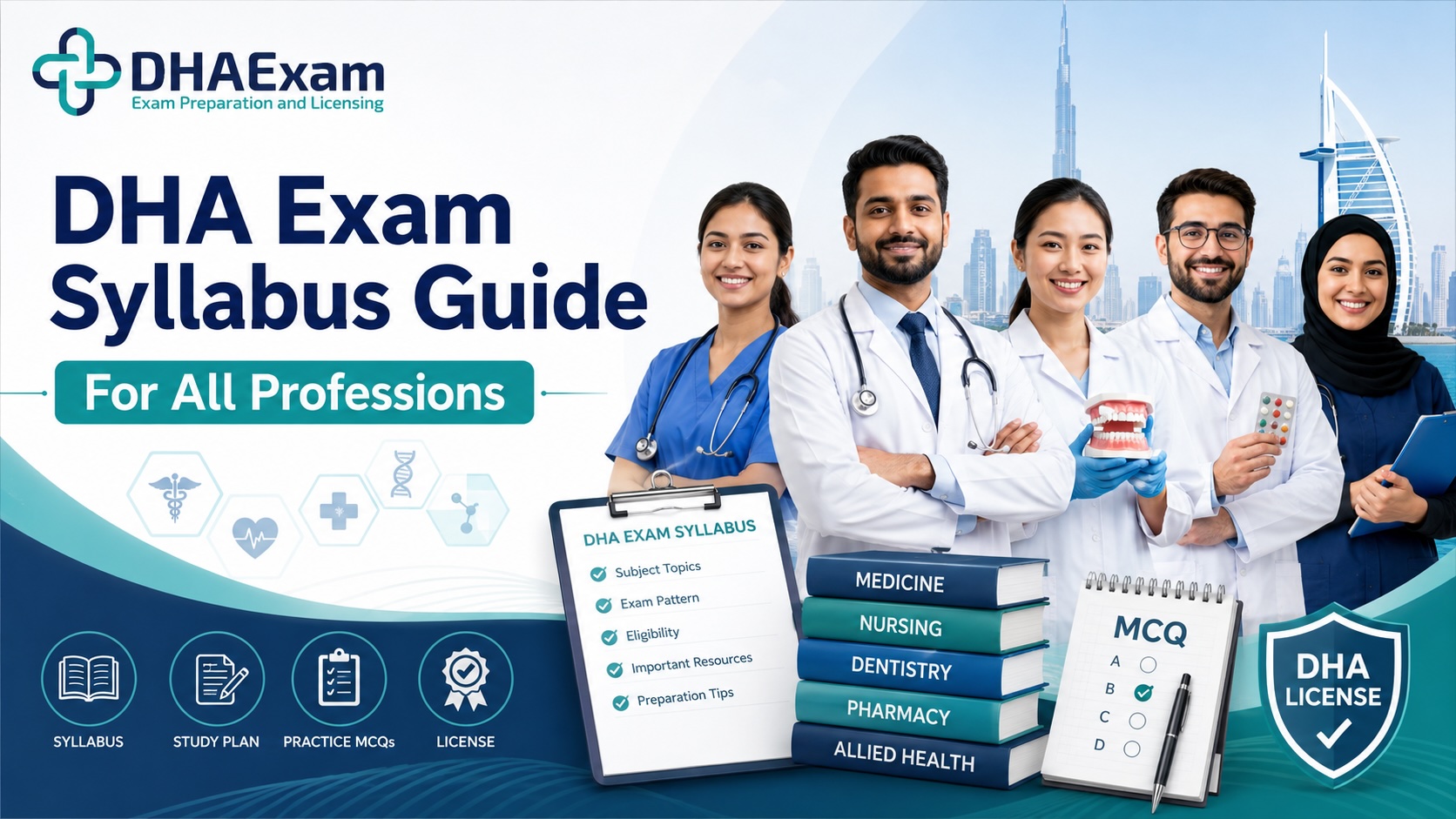
DHA Exam Syllabus Guide for All Professions
The DHA Exam syllabus is one of the most important things healthcare professionals should understand before starting exam preparation. Many candidates begin by collecting random MCQs, old PDFs, or mixed question banks without knowing which subjects matter for their professional title. This often leads to wasted time, weak preparation, and unnecessary stress before the exam.
Table of Contents
ToggleThe Dubai Health Authority exam pathway is not the same for every candidate. A general practitioner does not study the same syllabus as a nurse. A pharmacist does not need the same MCQs as a dentist. A radiographer, physiotherapist, optometrist, laboratory technician, anesthesia technician, and other allied health professionals each have profession-specific topic areas.
This guide explains how the DHA MCQ syllabus is organized across different professional groups, what topics are usually important, how to use the DHA Prometric syllabus for planning, and how to prepare for the DHA professional exam in a structured way. If you are preparing for a healthcare exam Dubai pathway, this article will help you study with better direction.
Start DHA Exam Syllabus-Based Preparation
Choose profession-specific DHA MCQs and mock tests based on your title, syllabus, and exam category.
Key Takeaways
- The DHA Exam syllabus depends on your profession. Doctors, nurses, dentists, pharmacists, and allied health professionals have different exam topics.
- DHA exam topics are practical and profession-focused. The exam tests safe practice, clinical reasoning, technical knowledge, and patient care awareness.
- The DHA MCQ syllabus should guide your question practice. Avoid random MCQs that do not match your title.
- The DHA Prometric syllabus helps with timed exam preparation. Many computer-based assessments are MCQ-style and require speed, accuracy, and topic coverage.
- Passing the exam is only one step. Candidates may still need DataFlow, registration, and license activation before practicing in Dubai.
What Is the DHA Exam Syllabus?
The DHA Exam syllabus refers to the professional knowledge areas and topics that candidates should study before taking a DHA licensing assessment. It may include clinical subjects, professional ethics, patient safety, technical skills, diagnostic reasoning, medication safety, equipment operation, infection control, emergency care, and profession-specific practice standards.
The syllabus is not always presented like a school textbook. For many healthcare titles, candidates use the official DHA CBT Assessment Guideline, mode of exam information, and professional qualification requirements to understand the exam category and topic coverage. DHA’s Self Assessment Tool page links to the CBT Assessment Guideline and mode of exam information, while the Get Registered service explains that applicants may need assessment depending on the professional position.
The key point is simple: do not study a general DHA syllabus. Study the syllabus for your exact professional title.
Why the DHA MCQ Syllabus Differs by Profession
The DHA MCQ syllabus differs because each healthcare profession has a different scope of practice. A nurse must understand nursing care, infection control, medication administration, patient safety, and clinical prioritization. A pharmacist must understand drug interactions, dispensing, counseling, and calculations. A dentist must understand oral surgery, periodontics, endodontics, restorative dentistry, and patient safety. A radiographer must understand imaging, radiation protection, positioning, and equipment operation.
This is why one question bank cannot properly prepare every professional. You should choose preparation material that matches your category and applied title. For active title-based preparation, visit DHA Exam Preparation.
DHA Exam Topics by Main Professional Group
The table below gives a practical overview of common syllabus focus areas by professional group. Exact topics may vary by title and official updates, but this helps candidates understand how preparation should be organized.
| Professional Group | Common DHA Exam Topics |
|---|---|
| General Practitioners and Doctors | Clinical medicine, chronic diseases, emergencies, pediatrics, women’s health, surgery, psychiatry, dermatology, ENT, screening, ethics, and patient safety. |
| Nurses | Fundamentals, medical-surgical nursing, pharmacology, maternity, pediatrics, infection control, prioritization, emergency care, and documentation. |
| Dentists | Oral medicine, oral surgery, periodontics, endodontics, restorative dentistry, pediatric dentistry, orthodontics, anesthesia, ethics, and patient education. |
| Pharmacists | Pharmacology, therapeutics, interactions, calculations, dispensing, counseling, prescription review, medication safety, and pharmacy law. |
| Allied Health | Profession-specific technical knowledge, patient care, safety, equipment, clinical reasoning, infection control, and ethical practice. |
DHA Prometric Syllabus and Exam Format
The term DHA Prometric syllabus is commonly used by candidates because many DHA computer-based assessments are delivered through Prometric. For many professions, the exam is MCQ-based and timed. The official CBT guideline explains that the exam format is multiple-choice questions and that results are updated as Pass or Fail in the applicant’s Sheryan account.
The number of questions, exam duration, fees, pass score, and code vary by professional title. For example, several professional assessments list 150 questions and 3 hours, but the pass score can differ by category. Candidates should always verify the latest official guideline before booking because exam rules can change.
For final test-day planning, read the active DHA Exam Checklist Before Test Day.
DHA Exam Syllabus for Doctors and General Practitioners
Doctors preparing for the DHA professional exam need clinical decision-making and safe practice knowledge. General Practitioner candidates usually focus on broad primary care topics, while specialists need title-specific preparation.
Common GP and Physician Topics
- Chronic diseases such as diabetes, hypertension, asthma, COPD, and thyroid disease
- Acute medical problems such as fever, chest pain, abdominal pain, headache, dizziness, and infections
- Pediatric problems, vaccination, dehydration, fever, respiratory symptoms, and child safety
- Women’s health, contraception, pregnancy warning signs, menstrual disorders, and screening
- Emergency problems such as stroke, chest pain, sepsis, anaphylaxis, shock, and severe asthma
- Common surgical presentations, dermatology, ENT, eye problems, psychiatry, family medicine, and screening
For GP-specific preparation, use the active DHA General Practitioner Exam Questions page.
DHA Exam Syllabus for Nurses
The nursing syllabus is broad because nurses are involved in direct patient care, medication administration, monitoring, education, and safety. Nursing questions often test practical judgment, prioritization, and safe care.
Common Nursing Topics
- Fundamentals of nursing and patient care
- Medical-surgical nursing
- Medication administration and pharmacology basics
- Infection prevention and control
- Maternal and child health
- Emergency nursing and patient prioritization
- Documentation, communication, and ethics
Nursing candidates should prepare with nursing-specific questions, not general medical MCQs. For nursing preparation, use DHA Nursing Exam Questions.
DHA Exam Syllabus for Dentists
Dentists should focus on clinical dentistry, diagnosis, treatment planning, and patient safety. Dental MCQs may include case-based questions involving pain, infections, radiographs, treatment choices, and emergency management.
Common Dental Topics
- Oral medicine and oral surgery
- Endodontics and dental pain
- Periodontics and implant basics
- Restorative dentistry and dental materials
- Pediatric dentistry and orthodontic basics
- Dental anesthesia and pain management
- Infection control, patient education, and ethics
Dental candidates can prepare through the active DHA Dental Exam Questions page.
DHA Exam Syllabus for Pharmacists
Pharmacist candidates should prepare with a strong focus on medicine safety and practical pharmacy decisions. The exam can test drug knowledge, prescription review, counseling, calculations, and interactions.
Common Pharmacy Topics
- Pharmacology and therapeutics
- Drug interactions and contraindications
- Adverse drug reactions
- Prescription review and dispensing practice
- Pharmacy calculations
- Patient counseling and communication
- Pharmacy law, ethics, and medication safety
Pharmacist candidates can use DHA Pharmacist Exam Questions for title-specific MCQ practice.
DHA Exam Syllabus for Allied Health Professionals
Allied health is a large category. The syllabus depends heavily on the exact profession. A physiotherapist studies rehabilitation and movement science, while a radiographer studies imaging and radiation safety. A lab technician studies hematology, microbiology, biochemistry, and quality control. An optometrist studies optics, refraction, and ocular disease.
| Allied Health Title | Typical Syllabus Focus |
|---|---|
| Physiotherapist | Biomechanics, anatomy, clinical reasoning, therapeutic exercise, electrotherapy, neurorehab, sports rehab, cardiopulmonary PT, and musculoskeletal rehab. |
| Radiographer | Radiation protection, X-ray, CT, MRI, ultrasound, fluoroscopy, anatomy, patient management, equipment, safety, and ethics. |
| Lab Technician | Safety, quality control, hematology, microbiology, biochemistry, blood bank, urinalysis, immunology, serology, and parasitology. |
| Optometrist | Optics, refraction, ocular anatomy, binocular vision, contact lenses, ocular disease, pediatric optometry, low vision, and environmental optometry. |
| Anesthesia Technician | Airway, anesthesia machine, respiratory support, monitoring, transfusion, crisis management, infection control, ethics, and anesthesia types. |
For allied health preparation, visit DHA Allied Health Exam.
Choose the Right DHA MCQ Syllabus
Match your MCQ package with your professional title, not with a generic DHA question bank.
How to Study the DHA Exam Syllabus
Studying the syllabus is not the same as reading everything once. A strong preparation plan turns the syllabus into a daily study structure.
- Confirm your exact professional title. Do not start preparation until you know the correct title and assessment pathway.
- List the main syllabus topics. Divide them into high-yield and weak areas.
- Start with topic-wise MCQs. Build understanding before taking full mock tests.
- Review explanations carefully. Learn why answers are correct and why other options are wrong.
- Use timed mock tests. Practice speed, focus, and exam stamina.
- Repeat weak topics. Your mistakes should guide the final revision week.
6-Week DHA Syllabus Study Plan
| Week | Focus | Action Plan |
|---|---|---|
| Week 1 | Syllabus mapping | Confirm title, collect topic list, organize documents, and start core revision. |
| Week 2 | Core topics | Study high-yield areas and solve topic-wise MCQs daily. |
| Week 3 | Secondary topics | Cover remaining syllabus areas and review weak sections. |
| Week 4 | Mixed MCQs | Move to mixed question sets and timed practice. |
| Week 5 | Mock tests | Take full mock tests and review every wrong answer carefully. |
| Week 6 | Final revision | Repeat weak topics, prepare test-day documents, and avoid last-minute cramming. |
Common Mistakes When Studying the DHA Prometric Syllabus
- Using a generic question bank instead of profession-specific MCQs
- Ignoring official topic coverage and studying randomly
- Studying only theory without timed mock tests
- Memorizing answer keys without understanding explanations
- Skipping patient safety, ethics, and professional practice topics
- Preparing for the wrong professional title
- Not reviewing weak topics before the exam
- Ignoring DataFlow and licensing documents while preparing for the exam
For a complete strategy article, read Common DHA Exam Mistakes and How to Avoid Them.
DHA Exam Syllabus and Licensing Steps
Understanding the syllabus helps you pass the exam, but it does not complete the full licensing pathway. Candidates may still need eligibility review, DataFlow verification, Sheryan application steps, registration, and license activation. DHA’s Get Registered service explains that applicants submit required documents, may pass assessment if required, and receive registration through Sheryan when approved.
For active licensing support, visit DHA License. For general exam guidance, browse the active DHAExam.com blogs.
10 FAQs About DHA Exam Syllabus
The DHA Exam syllabus is the list of professional topics and knowledge areas candidates should study before taking a DHA licensing assessment. It varies by professional title and may include clinical knowledge, technical skills, patient safety, ethics, and profession-specific practice topics.
No. The DHA MCQ syllabus is different for each profession. Doctors, nurses, dentists, pharmacists, and allied health professionals need different preparation because their scope of practice and exam topics are different.
Common topic types include clinical reasoning, patient safety, infection control, ethics, emergency care, technical skills, medication safety, diagnostic reasoning, and profession-specific knowledge. The exact topics depend on the applied title.
The DHA Prometric syllabus is the exam topic coverage candidates use when preparing for DHA computer-based assessments delivered through Prometric. It should be matched with the exact professional title and official assessment guideline.
Choose MCQs based on your professional category and title. For example, a pharmacist should use pharmacy MCQs, a dentist should use dental MCQs, and a physiotherapist should use physiotherapy MCQs.
Yes. Mock tests help candidates practice timing, question-reading skills, mixed-topic recall, and exam confidence. They also show weak areas before the real exam.
Many candidates prepare over four to eight weeks depending on their background, profession, work schedule, and current knowledge level. A structured plan is better than random long study hours.
Yes. Ethics, patient safety, infection control, and professional behavior are important across many healthcare exams. Candidates should not ignore these topics while focusing only on technical knowledge.
Passing the exam is a major step, but candidates may still need DataFlow verification, registration, employer application, and license activation before practicing legally in Dubai.
You can prepare through title-specific MCQs, mock tests, and syllabus-based study material. DHAExam.com provides preparation support through active exam preparation pages for multiple healthcare professions.
Conclusion
The DHA Exam syllabus is not one universal subject list for every healthcare worker. It depends on your profession, title, and assessment pathway. Doctors, nurses, dentists, pharmacists, and allied health professionals all need different topic coverage and different MCQ practice.
The best approach is to confirm your title, study the correct DHA exam topics, practice the right DHA MCQ syllabus, take timed mock tests, and prepare your licensing documents early. If your goal is success in a healthcare exam Dubai pathway, syllabus-based preparation will help you study smarter and avoid wasted effort.
Prepare With DHAExam.com
Start profession-specific DHA Exam preparation with MCQs, mock tests, and licensing guidance for healthcare professionals.
Disclaimer: DHA syllabus coverage, exam details, pass scores, fees, assessment mode, and licensing requirements can change. Always verify your exact case through official DHA, Sheryan, and Prometric sources before applying or booking an assessment.